
Pickleball Courts
Pickleball Court Construction, Lighting & Shading
Court Setup
Build Your Pickleball Court
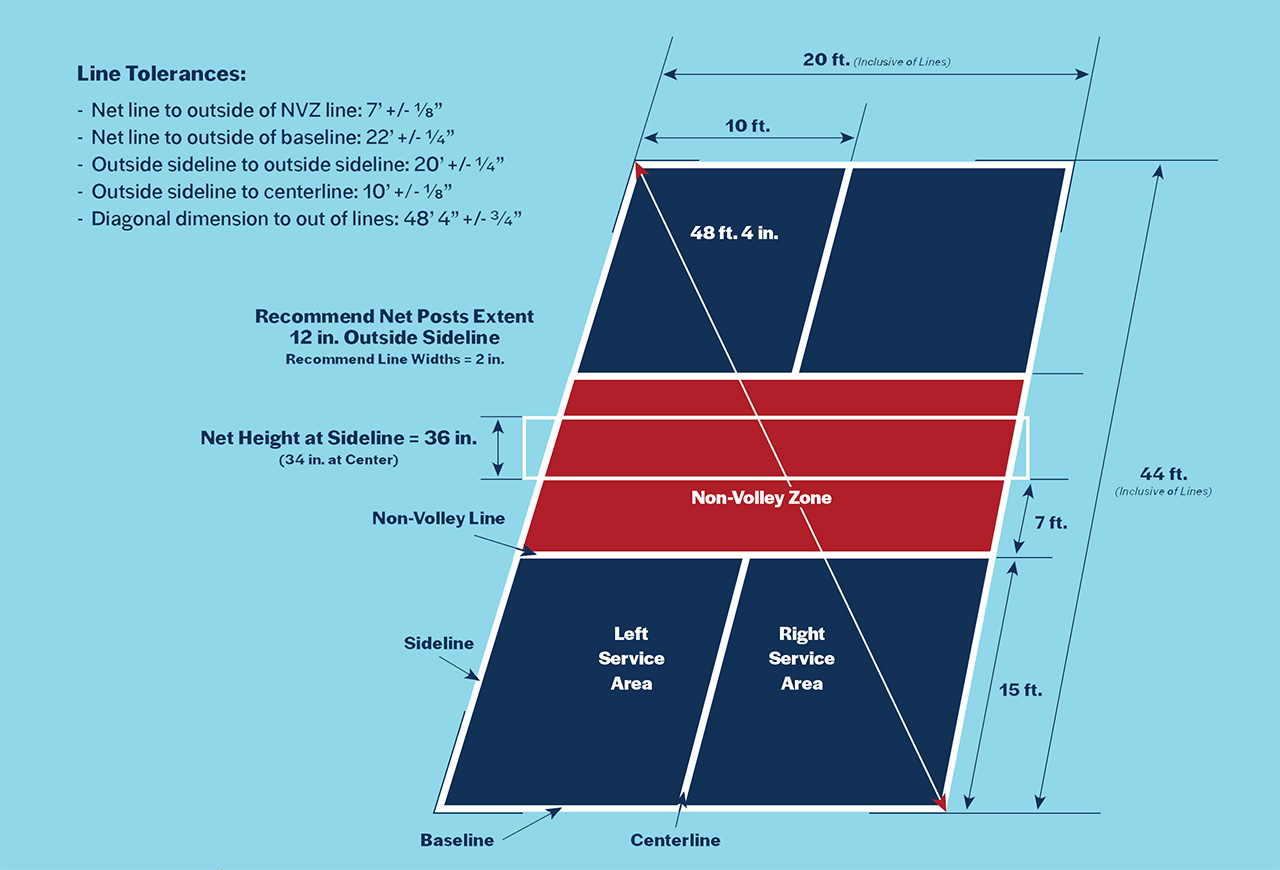
When laying out a temporary or permanent court, it’s essential to follow the official pickleball court dimensions as shown in the diagram. A regulation pickleball court measures 20 feet wide by 44 feet long. Courts should be oriented north–south outdoors to avoid players looking directly into the sun during morning or late-afternoon play—a common safety hazard.
Court Setup
Pickleball Court Dimensions
- Baselines: sit parallel to the net at the end of the court.
- Sidelines: running the length of the court.
- Non-volley zone (NVZ): the area on either side of the net bound in by a line parallel to and 7 feet from the net and two sidelines.
- Centerline: extends down the center from the baselines to the NVZ, dividing the court.
- Service area: the area beyond the NVZ on either side of the centerline, including the centerline, sideline, and baseline.
Official Court Partners








Build Your Court
Courting Building Resources

Lines
Lines can be made with chalk, tape, paint, chalk, or even crayons, but generally tape is the best option for DIY.

Surface
Any hard surface (i.e. concrete or asphalt) will suffice for outdoor gameplay, so long as it’s free of debris. Grass will not allow the ball to bounce, but driveways or cul-du-sacs can work fine with enough space. Ideally, the surface area should be about 30 feet by 60 feet. For more professional and permanent outdoor court surfacing, there are sport surfacing systems and services available.
Official Surface Partners
Netting
The net can be made out of any mesh material that will not allow a ball to pass through. It should be at least 21 feet 9 inches long, stretching from post to post; from the bottom edge to the top, it should be at least 30 inches wide. The posts should be 22 feet apart, and no more than 3 inches in diameter. Once the net is suspended from the posts across the center of the court, it should be 36 inches tall at the sidelines, and 34 inches tall in the center. The top edge of the net should have a cord or cable and it should be covered with a 2-inch tape.
Court Building and Fencing
As part of our commitment to growing the game of pickleball, USA Pickleball is partnering with industry-leading court builders. Our court building partners provide access to industry-leading court building technology that covers all aspects of the court building process for both commercial and residential customers.
Official Court Building Partners

Court Acoustics
As pickleball continues to grow in popularity and new outdoor courts open, USA Pickleball has invested in the research and creation of equipment and solutions to enable more communities the opportunity to enjoy the sport. The launch of a Quiet Category and Noise Reduced Category will recognize pickleball products that reduce acoustic output during play without negatively impacting performance. In addition to this effort, USA Pickleball is expanding its Facilities Development program to further support noise-reduction solutions for potentially sound-sensitive pickleball venues.

Lighting
There are many options for lighting a pickleball court, but it is recommended to use high-quality lighting solutions to avoid shadows and glare. USA Pickleball has partnered with LSI and MUSCO lighting to provide the best lighting solutions for our customers.
Official Court Lighting Partners

Court Shading
There are many options for lighting a pickleball court, but it is recommended to use high-quality lighting solutions to avoid shadows and glare. USA Pickleball has partnered with LSI and MUSCO lighting to provide the best lighting solutions for our customers.
Official Court Shading Partner

Facility Development Partner
Official Facility Development Partner

Setup A Court
Temporary Court Layouts
Pickleball Management Group (PMG) Rollout Pickleball Courts are available for sale or rent and can easily be installed in less than an hour. The Rollout Pickleball Court line features Indoor PVC rolls, which are 3.0mm and 2.0mm thick, and Outdoor Acrylic 3.0mm rolls. PMG also offers an exclusive Sub-floor system, PickleDeck, which can be installed on almost any type of surface to provide a high-quality pickleball court installation anywhere. See the FAQ section below for more detailed information

Rollout Pickleball Courts by PMG
- Available in 6′ wide rolls or less in any requested length. PMG’s rollout installation process significantly reduces seams on the court surface compared to using Court Tiles and Acrylic or PVC squares.
- Standard court dimensions are 30’x60′ using five 6’x60′ rolls weighing approximately 270 lbs. each.
- Due to an advanced 3D printing process, Rollout Indoor courts are offered in unlimited colors and graphics options.
- Outdoor courts are offered with a choice of any two colors and white logos.
- White game lines are included on all courts as a standard offering, unless another color is specified.
Rollout Court Temporary Use
- Ideal for events or regular temporary use on concrete, asphalt and wood surfaces.
- Portable courts using lighter weight material with smaller court dimensions can be designed to fit your needs.
- A full Indoor or Outdoor court can be installed or rolled up in less than an hour (three people recommended) requiring much less time and manpower than tiles, squares and one-piece court systems.
- Depending on the installation location and planned length of use, Rollout court rolls may not need to be adhered to the surface (consult PMG for details). Another advantage over installations with Acrylic or PVC Squares. However, you can seam the rolls together with single-side tape or adhere them to the surface with double-sided tape.
- The entire court can be transported in a custom crate provided by the manufacturer or on a pallet.
Rollout Court Permanent Use
- Ideal for commercial and residential applications.
- In addition to taping, partial or complete glue-down methods can be used depending on how permanent you want the installation to be.
- Available for Indoor and Outdoor applications.
PickleDeck Sub-floor System
- Ideal for use over damaged concrete and asphalt, grass, turf, carpet, compacted dirt/clay, gravel, etc.
- Includes 4’x4′ interlocking panels that prevent seams and provide a firm sub-floor over almost any surface type.
- Also ideal for backyard installations with minimal landscaping required, eliminating the need for concrete or asphalt slabs and building permits.
- Any type of Rollout court can be permanently or temporarily installed on top of PickleDeck.
- The entire system can move with you anytime you want.
- Lifetime Warranty included

Official Facility Development Partner
Sports Facility Planning & Development
At Ground Rule, the Official Facility Development Partner of USAP, is a network of companies with the common goal of continuously improving your organization by helping you solve big problems and bring bold ideas to life. As project managers and owner’s representatives, Ground Rule prioritizes your best interests at every turn. Their team of PMP-certified professionals brings a proven methodology to complete your project on-time and on-budget.
USAP-Ground Rule Facility Development Survey
Key Services Include
TAG Project Management
Project management and owner’s representation services that take projects from planning to completion.
Agile Risk Management
Expertise to mitigate organizational risk by advising on best practices, managing documentation, and implementing operational changes.
Blue Arrow Operations
Telling your story through event management, facilities operations, corporate and strategic partnerships.
Feasibility Studies: The Foundation for Successful Projects
Ground Rule understands the value of proper planning for a pickleball facility project. They will use their customized data analytics process and unique subject-matter expertise to ensure you have the information needed to determine the project’s viability, obtain funding, and design and program the proposed facility. The result will be a custom Feasibility Study outlining key data needed for all stakeholders.
Detailed sections include:
- Introduction
- Market & Demographics
- Industry Trends
- Case Studies & Competitor Analysis
- Location-Based Analysis
- Concept Development (Including a Cost Estimate)
- Programming Opportunities
- Economic Impact Analysis
- Financial Pro Forma
- SWOT Analysis
- Conclusion and Next Steps
Benefits of a Feasibility Study
- Provides Objective Data for Decision Making
- Serves as Early Risk Mitigation
- Helps Secure Funding
- Optimizes the Facility Program
- Enhances Stakeholder Alignment
Owner’s Representation: Safeguarding Your Interests
After completing the Feasibility Study, if you decide to move forward with facility construction, Ground Rule can act as your owner’s representative (no obligation)
through all project phases, providing full-service project management. They carefully review all project information and represent you, the owner, in all project-related matters. Ground Rule navigates the technical aspects of your project and ensures it is completed to the standards required.
We can help:
- Identify and Secure a Site
- Manage Agreements and Onboard Service Providers, the Project Architect, Contractors, and any Third-Party Consultants
- Coordinate All Efforts with Strategic Partners, Associations, and Other Stakeholders
- Oversee All Critical Aspects of Your Project—from Pay Applications and Budgets to Schedules and Beyond
- Maintain Consistent Communication with the Owner
Benefits of Hiring an Owner’s Representative
- Saves Time & Money
- Mitigates Risks & Errors
- Uncovers Hidden Costs
- Increases Capacity
- On-Demand Expert Knowledge
- Increases ROI

Construction and Maintenance Manual
Latest Edition (2023)
The latest edition (2023) of Pickleball Courts: A Construction & Maintenance Manual has been released by the American Sports Builders Association (ASBA) and USA Pickleball. The 182-page manual details the design, construction, and maintenance of courts for pickleball, which is one of the fastest-growing sports in the U.S., with more than 24 million participants, according to the Sports & Fitness Industry Association. This book is published every three years, with the next edition slated for 2026.
Frequently Asked Questions
Have additional questions? Contact Us.
How much space is needed for a pickleball court?
What kind of base is required for a pickleball court?
Where can I find experienced pickleball court contractors for court construction and surfacing?
Finding knowledgeable sport contractors can be difficult, if you don’t know the right questions to ask. SportMaster Sport Surfaces is the official court surface partner of USA Pickleball & they can provide free qualified pickleball contractor referrals throughout North America. Click the following link to locate installers near you.
What is the pickleball court resurfacing process?
What are the best color combinations for use on a pickleball court?
Lighter colors will absorb less heat from the sun, resulting in a cooler playing surface.
Darker colors will absorb more heat from the sun. This will result in a warmer playing area. However, it will also help to melt snow and evaporate water quicker, which may be a benefit in certain areas.
Surface colors can have an effect on ball visibility during play. For best results, use a pickleball color that is opposite the surface color on a color wheel (the most contrast between colors). The human eye will spot the pickleball quicker when it flies over a contrasting surface color.
What kind of coating should be used to surface, or paint, pickleball courts?
What are the benefits of cushioned pickleball court surfaces?
Is there any difference between indoor and outdoor pickleball court surfaces?
How should should pickleball courts be cleaned?
How can I fix the cracks on my pickleball court?
There are a variety of crack repair options in the sport surfacing industry:
- Coatings alone will not fill cracks. Very small “hairline” cracks 1/8” or less can be filled and hidden with the base coating (Acrylic Resurfacer) properly mixed with sand.
- Traditional (ready to use) acrylic crack fillers and some mixed with Portland cement and sand, on-site.
- Multi-layer fabric, longer-term crack repair systems
- Full court overlay systems
- Pavement overlay or reconstruction
- None of the crack repair systems work 100% of the time, but they do extend the life of the court and keep in maintained. Qualified sport contractors can go over all of the options and recommend the best solution for the issues at hand.
What kind of nets are used on pickleball courts?
Court Fencing
- Fencing contains the ball within the confines of the court.
- Fencing should be rust-proof and free of protrusions that could injure players.
- Chain link fencing is a cost-effective option that allows for both maximum visibility and light to pass through the fence, but other options include orange construction fencing, or plastic garden fencing.
- The ball is about 65mm so any openings in the fence should be small enough to prevent the ball from leaving the court area. 45mm or 55mm links are recommended.
- Backstops: Minimum height of 10 feet, but taller if there are problems associated with the ball leaving the confines.
- Sidestops: Should not be less than 3 feet in height. Minimum height should be the same as the backstop for at least 20 feet from the backstop, with 30 feet being more recommended.
- Gates: Should be present on both ends of the court to allow access, and wide enough to allow for wheelchairs/maintenance equipment.
- Windbreaks: Recommended to deflect the wind from interfering with play, while also providing a background against which the ball can be seen.
Court Lighting
Because of the fast-moving nature of pickleball, lighting is key. Players are required to react quickly, and visibility is essential to gameplay. Ideally, when considering lighting for the court, one should strive to have as much light as the budget affords. Other considerations include:
Quality of light:
- Should be uniformly spread throughout the area of play
- Should adequately render color
- Glare should be minimized as much as possible by avoiding reflective surfaces and controlling the amount of light on the court
Sources of Light:
- High Intensity Discharge (HID) lamps: last on average 12,000 hours and require a warm-up time of 3-12 minutes but achieve maximum light output
- LED lighting: Last up to 100,000 hours, costs less, require less maintenance and can be used with dimmers
Wiring:
- Should be underground if possible, outside of the court area
- Consider wiring multiple courts separately so each can be operated individually to save costs
Light Poles:
- A minimum distance of 5 feet from the sideline to light poles is recommended, and padding should be considered if they are inside the fence.
- Should be centered on or immediately outside the fence or court if possible
- Should not be used as fence posts
- The bigger the area, the higher the light poles need to be
Indoor Lighting:
- Direct lighting: direct light downward onto the court, but have potential to create glare so positioning and quantity should be considered so participants don’t look directly into them while playing
- Indirect lighting: aim light upward at highly reflective ceilings, providing very little glare, but also very few shadows, potentially making ball tracking more difficult
- A combination of the two may be the best option
- Sources can include LED, HID, and fluorescent, which can last around 40,000 hours and offer low glare with high efficacy
Pickleball Court Accessories & Amenities
- Nets, Posts, Center Straps
- Windscreen, Divider Netting, and other netting
- Sound proofing (Acoustifence/Acoustiblok mention)
- Court benches
- Shade Shelters
- Power & Water
- Spectator Seating
- Organizers & Ball Holders