
USA Pickleball Adaptive Play
Pickleball Wheelchair Rules
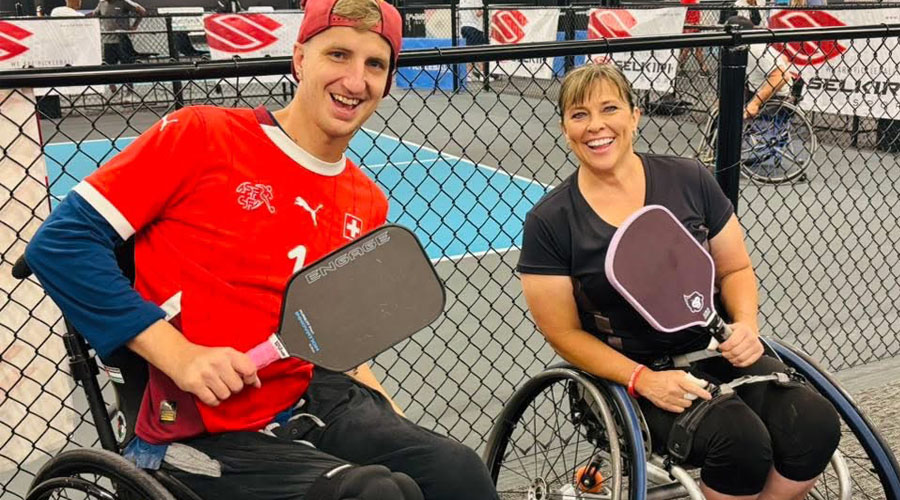
Pickleball Wheelchair Rules
The following is a quick reference guide for Wheelchair players, as well as referees, identifying rules unique to Wheelchair play from the 2026 USA Pickleball Rulebook. Part IV of the 2026 USA Pickleball Rulebook contains the Rules for Inclusive Play.
Rule 25.A Wheelchair Play – Section 25.A applies to wheelchair players and events that include one or more wheelchair players.
Rule 25.A.1 Player Eligibility – An eligible wheelchair player is any person, with or without a disability, who plays the game in a wheelchair.
Rule 25.A.4 Part of Body – A player’s wheelchair is considered part of the player’s body. The large rear wheels are treated like a standing player’s legs for positioning.
25.A.8 Serving – The moment the ball is served, both large rear wheels must be on the playing surface behind the baseline and must not touch anywhere outside the correct serving area. The front (smaller) wheels are allowed to extend into the court when the serve is hit.
Rule 25.A.9 Two – Bounce – Allowance. A wheelchair player may allow the ball to bounce twice before returning the ball. The second bounce can be anywhere on the playing surface.
25.A.10 – Volleying – The front (smaller) wheels and the rear stabilizing wheels may contact the non-volley zone at any time.
25.A.10.a – Fault Non-Volley Zone Contact While Volleying. When a large rear wheel of the player’s wheelchair, or anything that has contact with the volleying player (including the player’s partner) contacts the non-volley zone, it is a fault against the player.
25.A.10.b – Fault – Non-Volley Zone Momentum. When a volleying player’s momentum causes a large rear wheel of the player’s wheelchair to contact anything (including the player’s partner) that is in contact with the non-volley zone, even after the ball becomes dead, it is a fault against the volleying player.
25.A.12 – Tournament Events. Wheelchair players may compete in any tournament event, other than an adaptive standing-only event, and may partner with or compete against either standing players, adaptive standing players, or wheelchair players. Only wheelchair players are allowed to play in wheelchair-only events. In all cases, the specific rules governing wheelchair players apply to any player who uses a wheelchair, regardless of the event format or the classification of their opponents or partners.