By Steve Drumwright – Red Line Editorial
If you’ve ever seen or played in an intense pickleball rally with the four players just on the outside of the kitchen, you have undoubtedly seen someone get smacked by the hard, plastic ball.
It happens, just part of the game. The ball is already traveling at a high rate of speed in those close quarters.
But what if those same players were suddenly hitting the ball 5 or even 10 mph faster? The reaction time is lessened and the resulting injury frequency and severity would rise. That can happen with changes to the paddle’s surface over time.
USA Pickleball is working to prevent this from happening.
That’s the goal of USA Pickleball’s new paddle-testing program, which it fully implemented at two Golden Tickets events earlier this year in Glendale, Arizona, and Las Vegas.
“What we don’t want is pickleball to start turning into target practice,” said Riley Burgess, USA Pickleball’s vice president of equipment compliance. “You’re going to get hit with a ball here and there, but you don’t want that outcome. That’s not fun. … We’re trying to maintain the sport that we love and, honestly, part of the [National] Governing Body’s responsibility is to continue to grow the participation of the sport.”
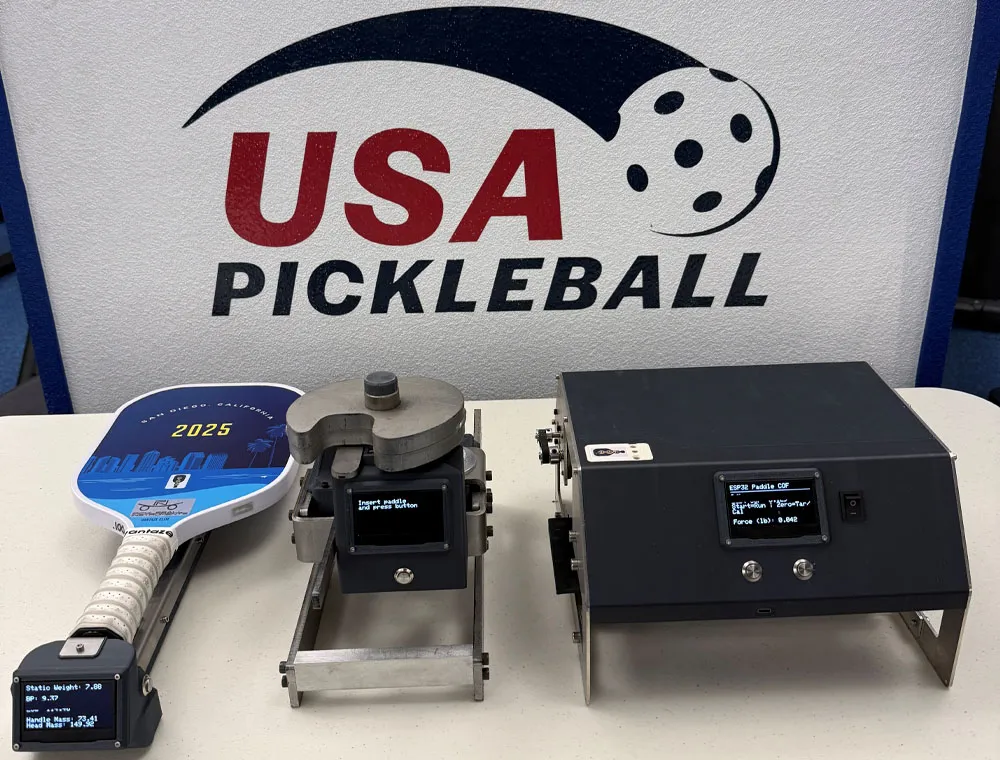
In conjunction with Pickleball Instruments, USA Pickleball has designed a program that tests paddles for a few things to ensure the surface integrity is within the desired range.
So far so good. Burgess said USA Pickleball has tested more than 2,000 paddles, with a mere 6 percent not meeting specifications. Paddles that fail the test are not allowed in the Golden Ticket events, so the player must find an approved paddle. When the paddle is approved, an official places an RFID sticker on it to track equipment data.
What does the testing entail? It is a very quick and simple test from a player perspective.
Testing is done before tournaments and takes less than five minutes. A machine analyzes the surface of the paddle, registering paddle-face deflection, the paddle’s integrity and delamination or structural changes.
There is also coefficient of friction testing, which notes paddle characteristics and how that changes over time and whether surface treatments are used. Finally, paddle measurements are also recorded. The next step will include performance data, including paddle-ball coefficient of restitution (bounciness) and spin measurements.
All of the information is stored on the RFID sticker and remains with the paddle after the tournament. That info, updated in real time, can be downloaded at the next testing site. There also is an app set to be released soon that can read the info from your phone. That means players at the local club can verify a tested paddle before a match.
Burgess enjoyed seeing about 50 paddles that were initially tested in Glendale be used in Las Vegas.
“We got very excited about that because we knew they already had the chip, so we didn’t have to put on a new chip,” he said. “Generally, not always the case, but over time, your coefficient of friction will go down and then generally your deflection will go up because your core is starting to break down slowly. We expect to see those trends and the trends will be different for every brand.”
Paddle brands are part of the process, too. Manufacturers can download the info from Pickleball Instruments and analyze the results to improve the life and performance of paddles.

The goal of the program is to ensure that all the players on the court — whether playing doubles or singles, mixed or same gender — are using equipment that is on the same level, eliminating potentially hot paddles.
Hot paddles are ones that, due to how long they have been used, develop characteristics that give them extra bounce — a “trampoline” effect, Burgess said — or the ball comes off at a greater speed due to the core being worn down.
Testing will also weed out counterfeit paddles. Burgess equates the current state of pickleball paddles to where golf clubs were when off-brand clubs were not only getting extra distance but also correcting the flight of the ball.
People will do anything to gain an advantage, even adding substances to the paddle to get more spin. And the knockoffs tend to cost less than the name brands. Burgess knows about both sports pretty well, having previously worked in sporting goods and now in the pickleball industry for 10 years.
But this testing program will put players who participate on the same footing, making pickleball about the skill of the player, not the equipment they use.
“The most common (test failure) is your paddle has broken down and there’s an education perspective to this,” Burgess said. “Some people probably know their paddle has gotten more powerful and others probably don’t. There’s just a lifespan to a paddle and when it breaks down, that’s the most common one we’re getting.”
Steve Drumwright is a journalist based in Murrieta, California. He is a freelance contributor to USA Pickleball on behalf of Red Line Editorial, Inc.