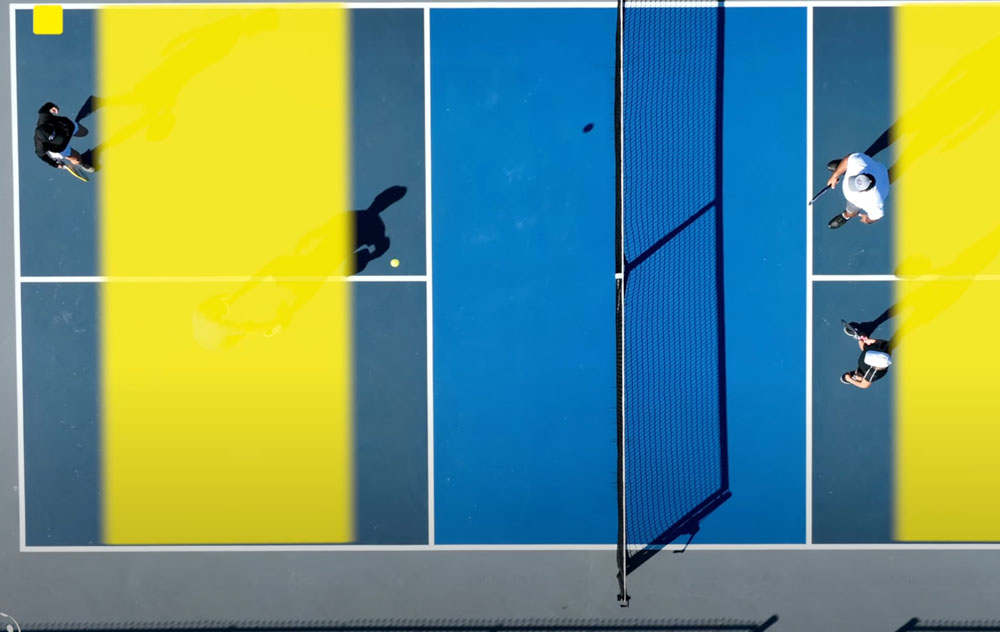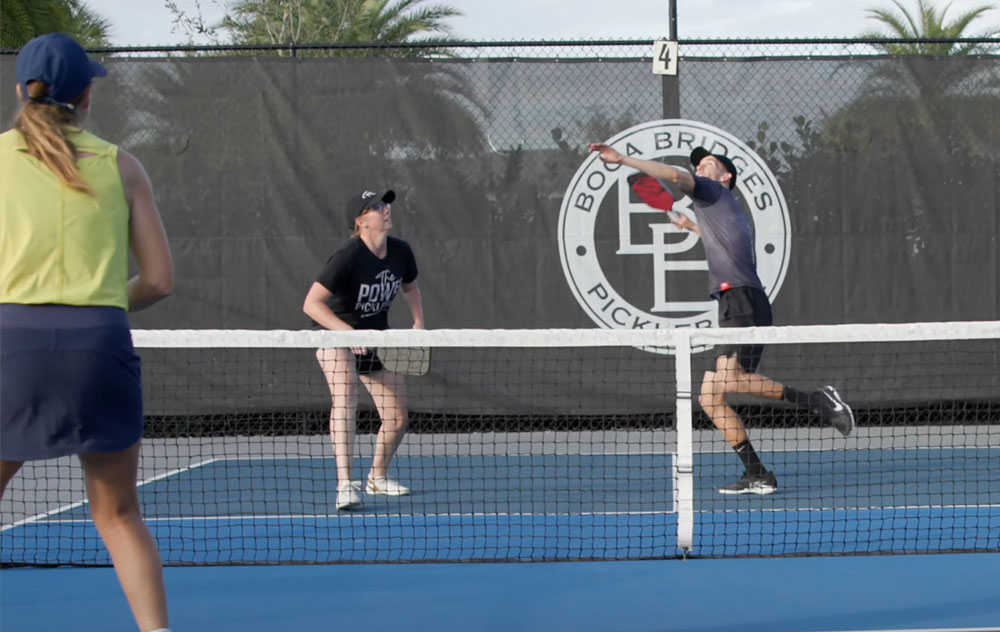
There are two ways to score pickleball games. Traditional/Side-Out scoring is still the official method of scoring pickleball games. However, in 2025, USAP provisionally recognized the introduction of rally scoring for both singles and certain doubles formats, marking a significant evolution in the game’s scoring options. For USAP-sanctioned tournaments, tournament directors now have the option to use Doubles rally scoring for Round-Robin and Team Play. Singles rally scoring can also be used for Double-Elimination play.
This change expands the use of rally scoring while ensuring it remains optional for tournaments not directly involved in qualifying for the USA Pickleball National Championships held in November. Traditional Side-Out scoring will stay in effect for all USA Pickleball Golden Ticket Tournaments and for the USAP National Championships.
TRADITIONAL SIDE-OUT SCORING EXPLAINED
Side-Out Singles Scoring
- With side out singles scoring a point is only awarded to the server when they win the rally.
- When the server loses a rally there is a side out and the opponent wins the serve.
- The serve is always made diagonally from the right side of the court when the server’s score is even and from the left side when the server’s score is odd.
- It is the server’s score that determines the serving and receiving position, not the score of the receiver. The receiver lines up on the right or left side according to the server’s score.
- The score is called as: server score, receiver score. (0 – 0)
- The game must be won by a two-point margin, which means the game may be played beyond the scheduled ending score.
Side-Out Doubles Scoring
- Points are scored only on the serve; the receiving side cannot score a point.
- At the start of the game, the player on the right side (even court) serves to the diagonally opposite court.
- If a point is scored, the server moves to the left side (odd court) and serves to the diagonally opposite court.
- Players on the serving side continue to move from the right to left or left to right each time a point is scored.
- Players on the serving team do not alternate sides unless a point is scored. The receiving side never alternates sides.
- The first server continues to serve until the serving team loses a rally and the serve passes to the second server on the team. [See * below for an exception]
- When the second server loses the serve, the service goes to the other team as a side out and the player on the right serves first, according to their score. That pattern continues throughout the game.
- Calling the Score:
- The score should be called as three numbers.
- Proper sequence for calling the score is: server score, receiver score, then, for doubles only, the server number: 1 or 2.
- To start a match, the score will be called as: zero – zero – two*
- The server number (1 or 2) applies for that service turn only. Whoever is on the right side (depending on the score) after a side out is the first server for that service turn only. The next time that the team gets the serve back, it might be the other player depending on the score. Beginning players can mistakenly assume that the player keeps the same server number throughout the game.
- When a team’s score is even, the player who served first in that game must be on the right (even) side of the court and on the left (odd) side when the score is odd. Or, expressed alternately, when the first server of that game is on the right side of the court, that team’s score should be even. If this is not the case, then either the players are positioned on the wrong side of the court or the called score is inaccurate.
*First Server Exception: To minimize the advantage of being the first team to serve in the game, only one player, the one on the right side, gets to serve on the first service turn of the game. Since the serve goes to the other side when that player loses the serve, that player is designated as the second server. Therefore, at the start of the game, the score should be called, “0-0-2.” The “2” indicates the second server and means that the serve goes to the other side when the serve is lost.
Service Sequence and Scoring – Mini Singles
- Both the server and receiver line up according to their score. Even score is Right Court and Odd Score is Left Court.
- The server starting the game will serve diagonally from the right, or even, side of the court.
- A point is scored when the server wins the rally just like Traditional singles.
- When a point is scored the server will change position to the Left or Odd court, but the receiver remains in the court corresponding to their score. Even = Right, Odd = Left.
- The server may be serving diagonal or straight away to the receiver.
- The server continues until they lose a rally.
- The new server aligns according to score and begins a new rally.
- The serve will alternate until one player reaches the game point and wins by two points over their opponent.
If there is not a two-point margin at game point the game continues until a two-point margin is met.