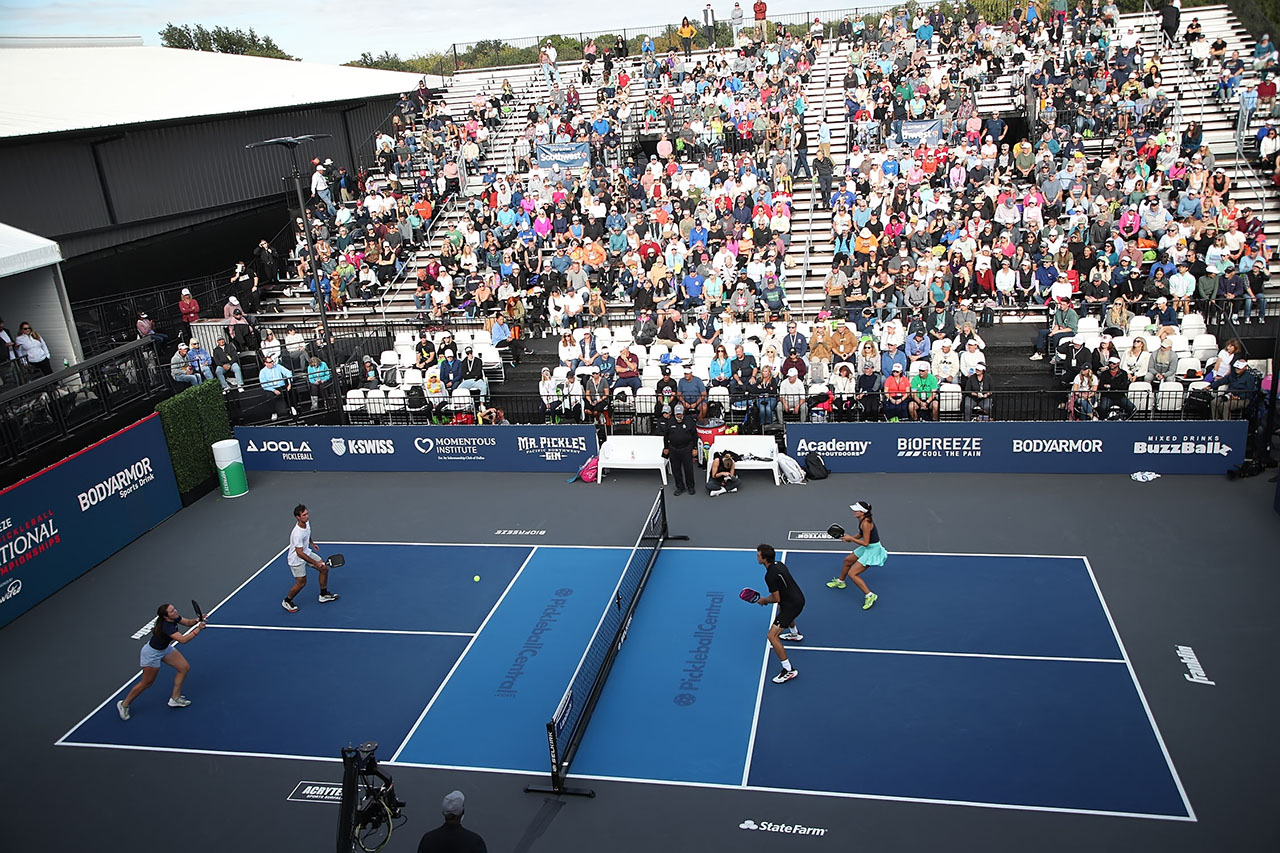
In doubles, pickleball poaching (moving onto your partner’s side of the court to intercept a shot) can be a game-changing strategy. When used correctly, it creates pressure, keeps your opponents guessing, and often results in quick winners. But not all poaches are the same. Players generally use two types: pre-planned poaching and opportunistic poaching. Understanding the difference, and how to signal effectively with your partner, is key to mastering this advanced pickleball doubles tactic.
Pre-Planned Poaching
Pre-planned poaching is usually done with a regular playing partner with whom you have had a chance to practice the technique. It may also be done in a pickup game by spending a few moments before the game to coordinate signals. Such impromptu signals usually work only with seasoned players that already understand the strategy.
A planned poach is usually executed by the receiving team after the return of serve. The receiver should try to return the serve deep and preferably crosscourt. Because of the two-bounce rule, the serving team must stay back near the baseline to play the return of serve. The serving-team player would then most likely return a crosscourt shot deep to the receiver. By planned agreement, the up player (closest to the net) on the receiving side would then cross over to the other side to cut that shot off and attempt a winner. The player in back would move to the other side. It is important for both players to not telegraph the poach. Wait for the hitter to commit to the shot. The normal strategy for the receiver in a non-poach situation is for the receiver to quickly follow his shot to establish position at the non-volley line. During a planned poach, the receiver may want to hang back to entice his opponent to try to hit a shot to him in the backcourt.
The planned poach is different from the opportunistic poach in that it is a full commitment to play the other side. There is no turning back. The poacher does not need to worry about a down-the-line shot on his original side of the court and does not need to worry about a lob over his head. He is counting on his partner to cover those shots.
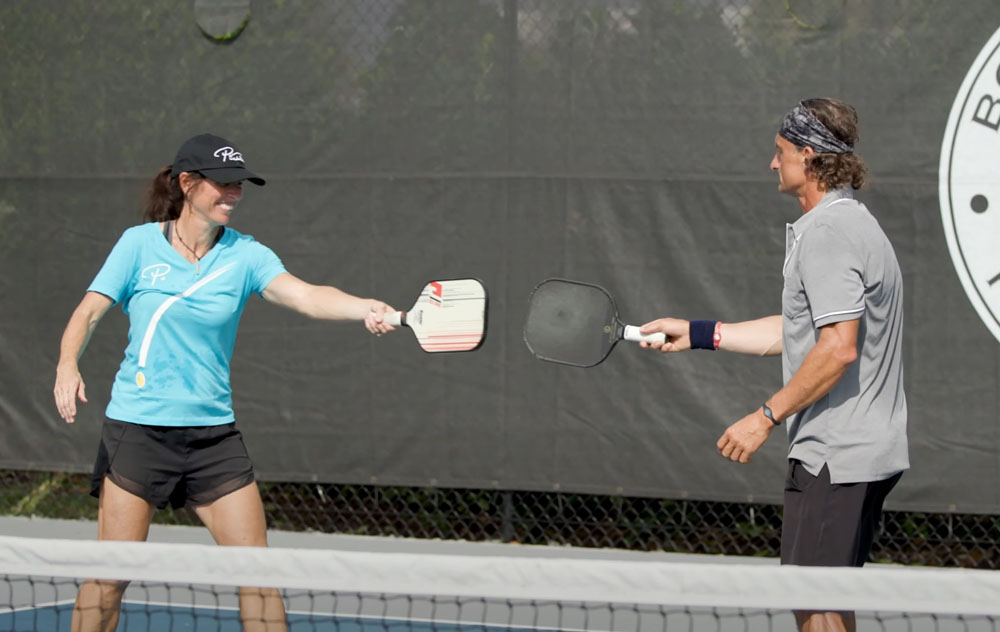
Players on the receiving team plan the poach with verbal signals or hand signals. Generally-accepted hand signals are for the up player to hold a hand behind the back with an open hand or closed hand. An open hand signals a poach, a closed hand indicates that the player will stay. Flashing open and closed signals a fake. The receiver should always acknowledge the signal so that there is no confusion. Verbal signals are usually given when both players meet momentarily at the center line with their backs to the opponents. It is important to always present the same look to your opponents. If you only hold your hand behind your back or meet at the center line when you are planning a poach, your opponents will quickly pick up on that.
The fake is a motion or step toward the other side of the court. The timing is different because you want to give your opponent time to change the shot and make a mistake. The fake is nothing more than a positioning and re-positioning of the body on the court. It should not be accompanied by actions such as stamping of the feet, waving the arms, yelling or talking to your opponent. Such actions would be considered unsportsmanlike and subject to a technical foul during a tournament.
If the signal is for a “fake” or “stay” it is still possible to execute an opportunistic poach as described in the next playing tip. The difference is the depth of the commitment and an understanding of which side of the court for which each player is responsible.
Opportunistic Poaching
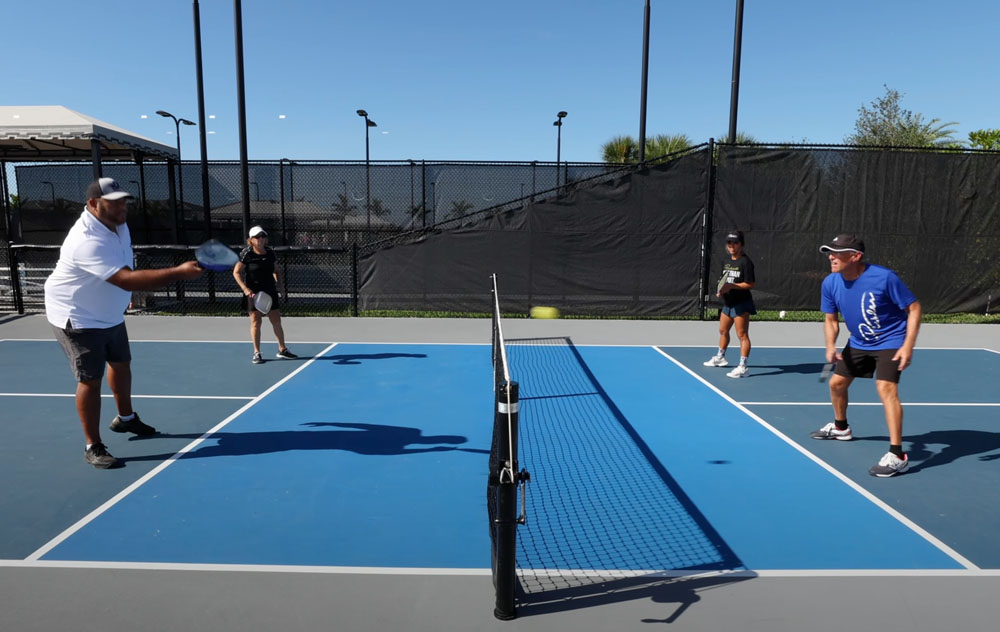
Poaching is the skill of moving onto your partner’s side of the court to pick off a shot for a winner. It is generally done when your partner is still well in back of the no-volley line. When your opponent is at the baseline and sees you up at the no-volley line and your partner in the backcourt, your opponent will usually return to the person that is in the backcourt. That is the ideal time for you to poach, especially if your opponent’s shot is a little higher and slower than a drive shot. It may not only result in an immediate winner but keep your opponent guessing the next time. If you let high, slow shots pass just a few feet from you just because they are on your partner’s side of the court, then you are doing your opponents a huge favor by letting them get comfortable in making easy shots to the backcourt.
Poaching is most effective when it is a surprise. If your opponent anticipates the poach, he may just hit behind you as you are moving across. Be unpredictable. Don’t tip your hand too soon. Time your move to the moment that your opponent is committed to the shot, usually just before the paddle contacts the ball. Poaching is a bold move that involves some risk, so don’t overdo it.
If you play with a regular partner, you can make a plan for when to switch sides and when to return to your own side. If you play with a variety of partners, it is good to have some general rules of thumb about when to switch. If the poacher only moves a step or so into his partner’s side, then it is generally safe to assume that he will move back to his own side. A further encroachment to his partner’s side would usually require a switch. To avoid confusion, the partner in back would say “switch” when it seemed desirable to switch. If possible, say “switch” immediately, before your partner has started to move back. Remember that the poacher cannot see you when you are in back of him. If you switch without telling your partner, then you have created the possibility of both players trying to cover the same side of the court.